Don't miss my next newsletter
Join 13,000+ reading first every week 👇 (completely free)
(having trouble signing up? Go here)
A Free Chapter From My Book...
The fitness industry has never had more information available than it does today, yet I think a lot of people are more confused about how to get in shape than they need to be.
And that was exactly me when I first started working out.
By the way, my name is Eric Evans, and I’m the founder of Average To Jacked. I teach people how to simplify fitness, build muscle, and get strong without having to live in the gym or make fitness their entire life.
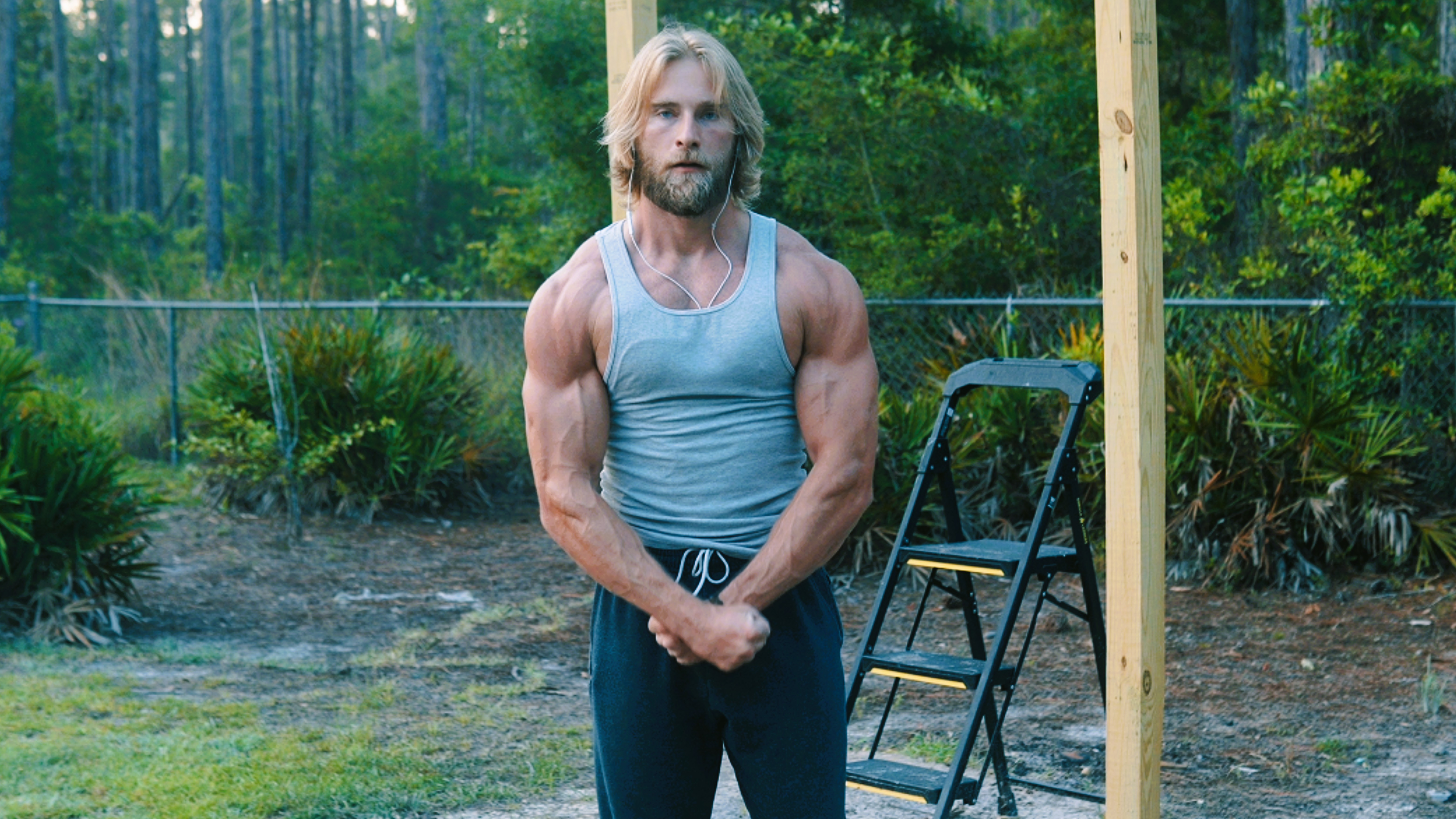
I started the Average To Jacked YouTube channel a little over a year ago, and since then it’s grown from zero to more than 250,000 subscribers. A huge reason I think it has connected with so many people is that my philosophy is pretty simple: you probably don’t need to do more. You need to get really good at doing the basics consistently.
That philosophy came from more than ten years of my own training, including plenty of years where I did the exact opposite. I overcomplicated my workouts, changed exercises constantly, spent way more time in the gym than I needed to, and consumed so much fitness information that I was always questioning whether there was something better I should be doing.
Over time, my approach became much simpler: train a few days per week, focus on key movements, train hard, track what you’re doing, progressively get stronger, eat according to your goal, recover, and repeat.
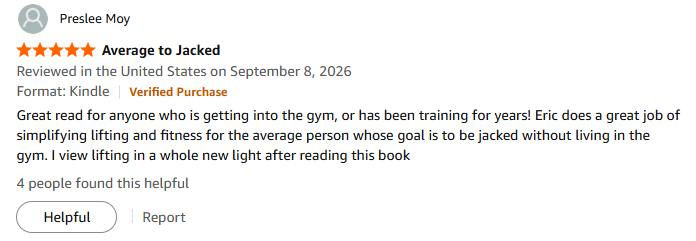
I recently put that entire philosophy into my first book, Average To Jacked: The Simple System to Build Muscle Without Living in the Gym, and I’m excited to be able to share one of the chapters with the HEVY community.
I specifically chose this chapter because it ties directly into what HEVY is built around: tracking your training and progress.
I spent years going to the gym without consistently writing down what I was doing. I worked hard, but I had no real data telling me whether I was actually progressing. Once I understood the difference between simply working out and actually training, having a "logbook" became non-negotiable for me.
Here’s Chapter 2 of Average To Jacked, The Log Book

In the previous chapter, I introduced the concept of progressive overload through the example of Milo of Croton, who carried a calf on his back.
Something Milo’s story did not show us was one of the biggest challenges of modern lifting: tracking progress.
Milo never had to wonder whether he was progressing. The animal was slightly heavier every day. Progressive overload was built directly into the task itself. Milo did not need to remember what he’d carried the week before because it was automatic.
The challenge was increasing whether he paid attention to it or not.
Unfortunately, weights sitting on a gym floor don’t become heavier on their own. A forty-five-pound barbell today will still be a forty-five-pound barbell next week, next month, and next year.
So if the demand placed on our muscles is going to increase, we must be the ones to do it. We must strategically increase it ourselves.
Most people unknowingly run into trouble with this. When they look back on months or years of disappointing progress, they often assume the problem was poor genetics, not taking the right supplement, their workout program, or their diet.
Those could’ve absolutely contributed to their disappointment. But when you look closely at most people in these situations—people who work out and never see the progress they hoped for—there’s a consistent pattern.
There’s no consistent progressive overload.
Many people work extremely hard in the gym and leave exhausted, without much (if any) muscle gains.
One difficult truth is that you can work extremely hard without measurable progress.
Hard work and measurable progress are not the same thing.
Exercising vs. Training
For a long time, I did not understand that distinction. I would drive to the gym with every intention of having a great workout—blasting music, drinking pre-workout, and getting in a good mindset for a good lifting session.
But by the time I walked through the front doors and scanned in my membership, I still didn’t have a solid plan.
My only goal was to work out and get a good pump. Beyond that, everything was pretty much decided in the moment—what muscle group I was training, what machines I wanted to use, rep ranges, etc. I would see machines I wanted to “try out” that I saw some influencer doing, then do that.
I would do highly variable workouts, usually training muscle groups and movements in different orders; sometimes I trained chest first, sometimes shoulders.
The entire workout was assembled piece by piece as I went along, on the spot.
Sometimes I would workout with a friend and follow his program for that day.
Nothing about that approach seemed unreasonable. I was showing up consistently, putting in genuine effort, and leaving the gym feeling like I had accomplished something.
From my perspective, I was doing exactly what dedicated people were supposed to do.
I assumed: Drive to gym + workout hard for 2 hours = result.
I was wrong.
The problem was that every workout existed in isolation. I had been exercising, but not actually training. There is a difference.
Once a session ended, there was no record of it. There was no clear indication of what had improved, what had stalled, or what needed to happen next.
By the time I returned to the gym a few days later, I was essentially starting the decision-making process all over again.
Looking back, it’s obvious why progress was slower than it should have been: I wasn’t tracking it.
Get Real Data
I had no reliable way of knowing whether the demands I was placing on my body were actually increasing.
I could think to myself “Yeah… I feel like I’m getting stronger” or I could convince myself I was making progress.
But without anything being tracked, those beliefs were little more than guesses.
Recovery and your “feelings” can fluctuate day to day. One workout might “feel” hard and the next workout might feel just as hard even though you’re doing ten percent less weight and fewer reps because of poor recovery outside of the gym.
If you slept poorly for several nights in a row, work has been unusually stressful, or your nutrition wasn’t as consistent as it should have been, this is a real possibility.
Maybe you simply accumulated more fatigue than your body was ready for.
So here’s an important Average To Jacked rule: never judge your workouts based on feelings. Judge your workouts based on actual data.
The key is that you have a way to track your workouts. This is a non-negotiable. You should never step foot out of a gym until you have written down all of your training or logged it digitally.
The moment you begin recording your training, workouts stop being isolated events and become part of a larger process. Instead of relying on memory, feelings, or assumptions, you have evidence.
You can see what happened last session, compare it to what happens today, and determine whether the demand on your muscles is actually increasing over time.
In other words, tracking the data becomes the bridge between the principle of progressive overload and its application in the real world.
To Reiterate: Tracking Is Non-Negotiable
At this point, some of you might be thinking, “Do I really need to track all this? Can’t I just remember it?”
This may sound reasonable, but it’s not. Life rarely works that way. Between work responsibilities, family obligations, appointments, errands, bills, emails, text messages, social media, and the dozens of other things competing for our attention every day, most of us are already trying to keep track of more information than we can realistically manage.
Even if you only do a few simple exercises, at a few simple weights, through a few simple rep counts, you’ll forget.
Even if you walk out of the gym fully convinced that you will remember exactly what happened, the details have a funny way of becoming less clear as the days pass.
Was that incline press 185 pounds or 190? Did I get eight reps or ten? Was my form sloppy? Did I stop because I reached failure or because I was distracted and cut the set short?
Most people end up far less certain of the answers than they think they’ll be.
That uncertainty might not seem like a big deal in the moment, but when your goal is to gradually increase the demands placed upon your body over months and years, small details matter.
The entire process depends on knowing where you left off so you can make an informed decision about where to go next.
Get a Logbook
A logbook is simply a method of tracking your training. It is a record of at least three key facts:
the exercises you perform
the weights you use
the number of sets and reps you complete
You can also include other information that helps you accurately measure progress over time, such as whether you complete reps to failure.
The format itself is largely irrelevant. A cheap notebook or legal pad from the store works. The notes app on your phone works. A dedicated workout tracking app works.
The specific tool matters far less than the habit. What matters is that you have some way of recording your training so that each workout builds upon the one before it instead of existing as a completely separate event.
Do it.
If you made it this far and this chapter helped simplify the way you think about training, that’s exactly why I wrote Average To Jacked.
The rest of the book takes these principles and puts them together into a simple system you can actually follow, including training, progression, nutrition, recovery, and the full three-day workout programs I recommend.
If you want to read the rest, you can grab Average To Jacked on Amazon here